Acid:
Bronsted-Lowry theory: Proton/ H+ donor
Lewis theory: Electron pair acceptor
Monday, October 9, 2017

Thursday, June 15, 2017
Empirical formula calculation
If given % of an element in compound:
- coefficient = percentage/molar mass
- If coefficient is halfway between two real values, multiply everything by 2.

Eg: 9.5 x2, 5.5 x2
Thursday, December 10, 2015
1.5 understand the terms atom and molecule
Atom is the smallest particle of an element. Consists of neutrons and protons in a nucleus, and electrons orbiting in shells around the nucleus
Eg A structure of an atom
Molecule is two or more atoms that are joined by covalent bonds.
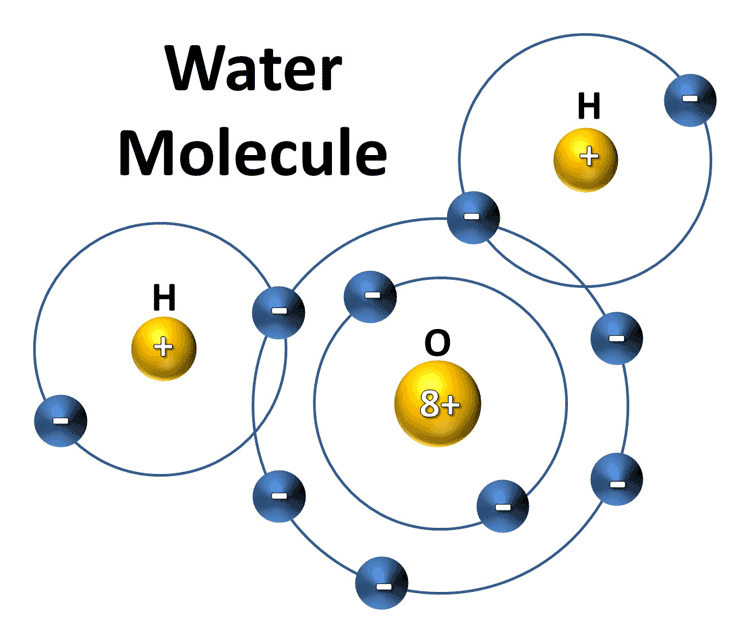
Eg A water molecule consists of two hydrogen atoms and an oxygen atom.
Wednesday, December 9, 2015
1.3 explain the changes in arrangement, movement and energy of particles during these interconversions
Solid: still; no energy; all particles touching
Add heat v / Remove heat ^
Liquid: Moving to fit space; some energy; all particles touching
Add heat v / Remove heat ^
Gas: Moving freely; lots of energy; particles not touching.
Add heat v / Remove heat ^
Liquid: Moving to fit space; some energy; all particles touching
Add heat v / Remove heat ^
Gas: Moving freely; lots of energy; particles not touching.
1.2 understand how the interconversions of solids, liquids and gases are achieved and recall the names used for these interconversions
The conversion between solid and gas is called sublimation, but is not needed for the IGCSE.
1.1 understand the arrangement, movement and energy of the particles in each of the three states of matter: solid, liquid and gas
Solid: particles are arranged in a lattice structure, tightly packed and no free spaces between each particle, do not move, can only vibrate.
Liquid: particles are randomly arranged, close together, with little space bewteen them and collide frequently.
Gas: particles are far apart and at random, move quickly, high energy in all and random directions.
Subscribe to:
Posts (Atom)